07.13.2026
Jokes
06.22.2026
Warrior Cats Thoughts
03.16.2026
Geometric Nightmares
12.05.2025
Salton Sea
11.06.2025
Wishing On Stars: A Review of Fancy Dancer
09.30.2025
Salem Witch Trials
A law student walks into a bar.
He fails.
What can a polite Irish pirate say about both his favorite ship and his cunty wife?
"Arrrg she be sea-wordy"
Book One: Into The Wild
Cry Count: 4
- I already love Bluestar
- BRUH a death already?? This just started
- Tigerclaw is pissing me off
- I would die for Yellowfang...
- Barley is a 10/10 cat name
- NOOOO LIONHEART GODDAMMIT D:
- I'm curious about medicine cat logistics... how do you source mouse bile? how do you perserve all of these herbs? who is gathering all of these plants?
- NOOOOOO SPOTTEDLEAF I'm going tO FREAK OUT WHAT THE FUCK
- !! How did I not realize Graypaw was Graystripe !?! Hell yeah!
- Starting the second book immediately.
Book Two: Fire and Ice
Cry Count: 5
- Bluestar is such a good leader. I'm glad she's not upset about Ravenpaw leaving the clan. I also think he'd probably be happier not as a warrior
- Good thing TallStar trusts Fireheart so much (for some reason)
- YES YES Ravenpaw is okay !!!!
- Bruh do NOT cut through RiverClan territory are you dumb
- WHAT DID I SAY
- Graystripe you messy slut. It's like Romeo and Juliet all over again.
- Okay so these guys have like... jobs to do?? Your clanmates are sick and hungry and you have apprentices,, why are you gallivanting about with random girls??? Either of you?????
- :(
- I cannot believe this. Why couldn't she have just stayed in the camp.
- I have a small little wish that one of these books will end with "and they all decided to get along and join into one big Clan where they all love each other and nothing bad ever happens again". But there's like 70 more books so...
- i NEED to know what the fuck Tigerclaw's game is. Is he really that desperate to be leader or is something else going on??
- How the hell is Fireheart gonna explain where he got this kitten
- HE'S HER SON??
- I'm glad Cinderpaw and Yellowfang are friends :))
- Graystripe needs to get his shit together. You're in love - I get it. Think critically for one second, dude!! But I'm glad him and Fireheart seem okay.
Book Three: Forest of Secrets
Cry Count: 4
- Open communication between anyone in this clan would do wonders
- 90% of what Fireheart does is sneak around and lie. Boys gonna get himself in trooouuble.
- This is NOT good news. This is gonna get so messy
- Goddammit, Cloudkit
- okay slay bluestar, once again exceptionally forgiving and understanding
- Cinderpaw's new path as medicine cat apprentice is getting me through this tbh. I love her and Yellowfang's relationship :') and I'm so proud that she's taken her injury in stride (no pun intended) and still doing the best she can
- I cannot believe WindClan and ShadowClan are THAT upset about Brokentail. What the fuck is he gonna do
- D: NOO SILVERSTREAM This is so beyond fucked
- Oh my GOD Tigerclaw fuck ooofff kim there's people that are dying
- I do not like Cloudpaw
- I. I'm. I'm flabbered, I'm gasted.
- Good job, Yellowfang, thats fucking rough. Also, the fact that she told him shes his mother after he ate the berries...
- okay, bluestar... thats certaintly... a choice...... why fireheart?? not whitestorm????
- If I had a nickel for every time a ThunderClan cat and a RiverClan cat fell in love and had kits, only for the kits to be given up to RiverClan and to grow up never knowing their mother, I'd have two nickels. which isn't a lot but its weird it happened twice.
- oh :(( bye greystripe...
Book Four: Rising Storm
Cry Count: 6
- Bluestar needs to get her shit together
- also Fireheart is doing a terrible fucking job, dude, he should not be deputy
- Cloudpaw better shape up or gtfo
- I bet he's eating at Princess's house :/
- BRUH NO ITS WORSE he's not even visiting his mom, he's just being gluttonous
- Oh Cinderpelt, you absolute sweetheart don't you dare get yourself sick <3333
- Cat romance
- what the fuck is Tigerclaws problem. he has been nothing but loved and trusted and respected by the clan until he betrayed and attacked them. he can get tf over himself
- slayyy ravenpawww! love my boy, always good to see him
- bluestar. my girl. my love. get your shit together.
- if yellowfang is dead, ill kms.
- leopardfur might be a bitch, but goddamn is she an honorable warrior
- also I take it back: Fireheart has been doing a very good job at being deputy. He's improving a lot.
- oh..... yellowfang.... :(
- NO FUCKING WAY TIGERCLAW GET THE FUCK OUT WHAT THE FUCK
Book Five: A Dangerous Path
Cry Count: 3
- Listen to your medicine cat you stupid boy
- graypool :(((
- okay so bluestar is actually being crazy. at what point can they force her to step down??
- oh no i was really hoping snowkit would grow up to have a i-dont-need-to-be-a-warrior-to-help-my-clan moment, like cinderpelt. but ig hes birdfood :(
- ohhh that's fucked up... rip swiftpaw
- BLUESTAR WHAT THE FUCK is actually wrong with you. naming her Lostface is literally just cruel. how fucking dare you do that to my girl.
- mm. I'm worried. a patrol to snakerocks is. scaring me.
- hell of an ending: tigerstar's plan, the dog chase, bluestar's deathbed redemption, the prophecy fulfilled, and still one more book aaaaaaaa
Book Six: The Darkest Hour
Cry Count: 5
- Tigerstar is in way over his head. This is not gonna work out
- crying in the bus station over Firestar's naming ceremony
- really?? murdering kits now, darkstripe???
- Everyone thinks Bramblepaw is gonna be an issue,, but I'm betting it'll be Tawnypaw...
- I wasn't expecting violent fascism but here we are ig
- okay fine I like Cloudtail now
- 👁👄👁 literally gutted...
- Tigerstar's death feels. bad and wrong. nothing is sacred.
- okay final battle, lots of death. I'm guessing: whitestorm, maybe greystripe (bc what else will they do with his character), an apprentice, and one more warrior like mousefur or frostfur
- ONLY WHITESTORM??? sobbing
- I. girl Greystripe does not deserve to be deputy are you kidding me bad decision
Ok banger series, enjoyed them wayy more than I thought I would. Will be reading series 2 and 3 also.
Total Cry Count: 27
In the summer of 2022, I took a very long road trip. Our route dictated by the cheapest gas, we took a left-turn off the I-10 after a long, hot morning of driving. After we filled our tank, we continued south, scanning the map for attractions.
If you're not familiar with the Salton Sea, let me fill you in. In 1905, a large irrigation canal was built to bring more water from the Colorado River into the Imperial Valley. It was terrible timing, as that year saw record-breaking rainfall. So, of course, the area flooded horribly over the next two years, displacing most of Salton City and the Torres Martinez Indian Reservation. The resulting sea was unable to drain, and farm land runoff kept it from drying up.
The state of California saw this as an excellent investment and spent the 1950s and 60s building resorts along the shore, stocking the sea with fish, and inviting tourists to enjoy outdoor recreation next to this new, beautiful oasis. The area flourished... briefly.
Lack of a fresh water source, agricultural runoff, evaporation, and leaching salt deposits filled the water with salt and chemicals. By the 1980s, fish and birds began to die off at alarming rates. The stench, a fear of deadly water, and two more disastrous floods left the resort town all but abandoned.
Nowadays, the area is home to farmers, the elderly, the eccentric, and an abundance of art installations. Toxic dust from the sea causes serious health issues for those who still live in the area.
Bombay Beach:
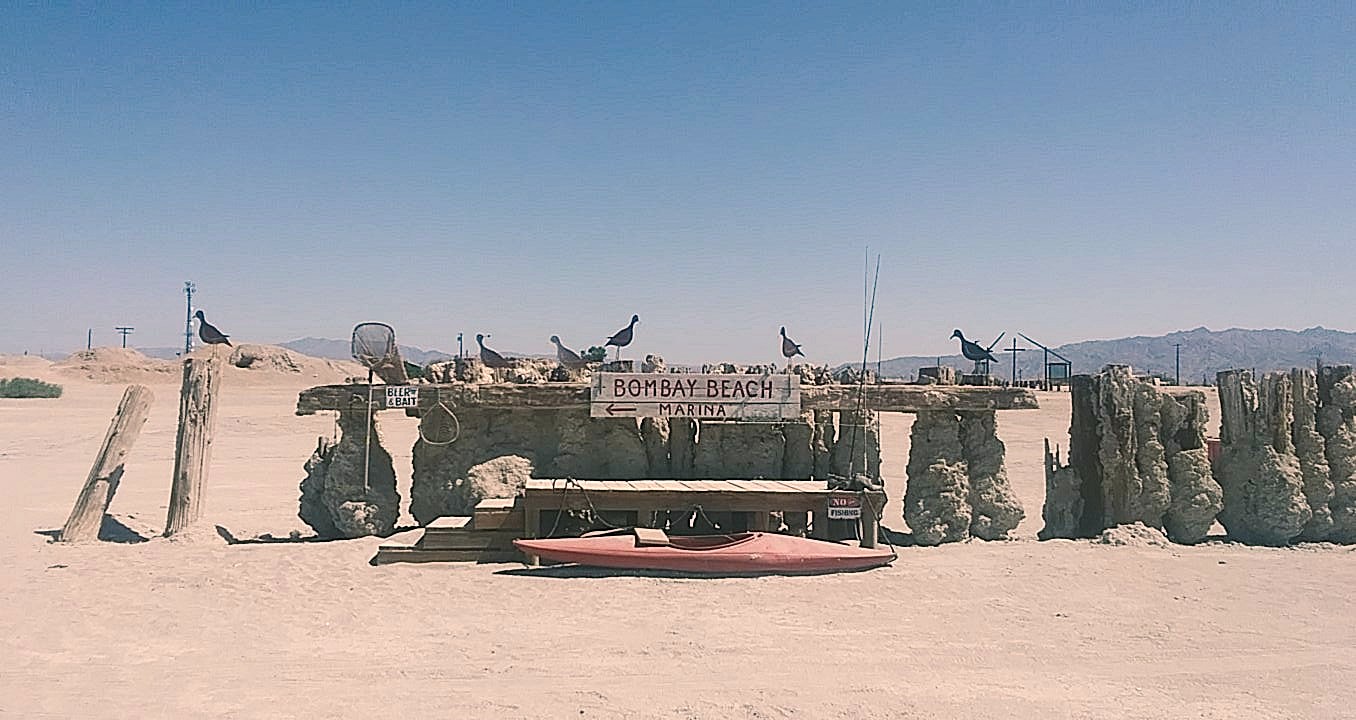
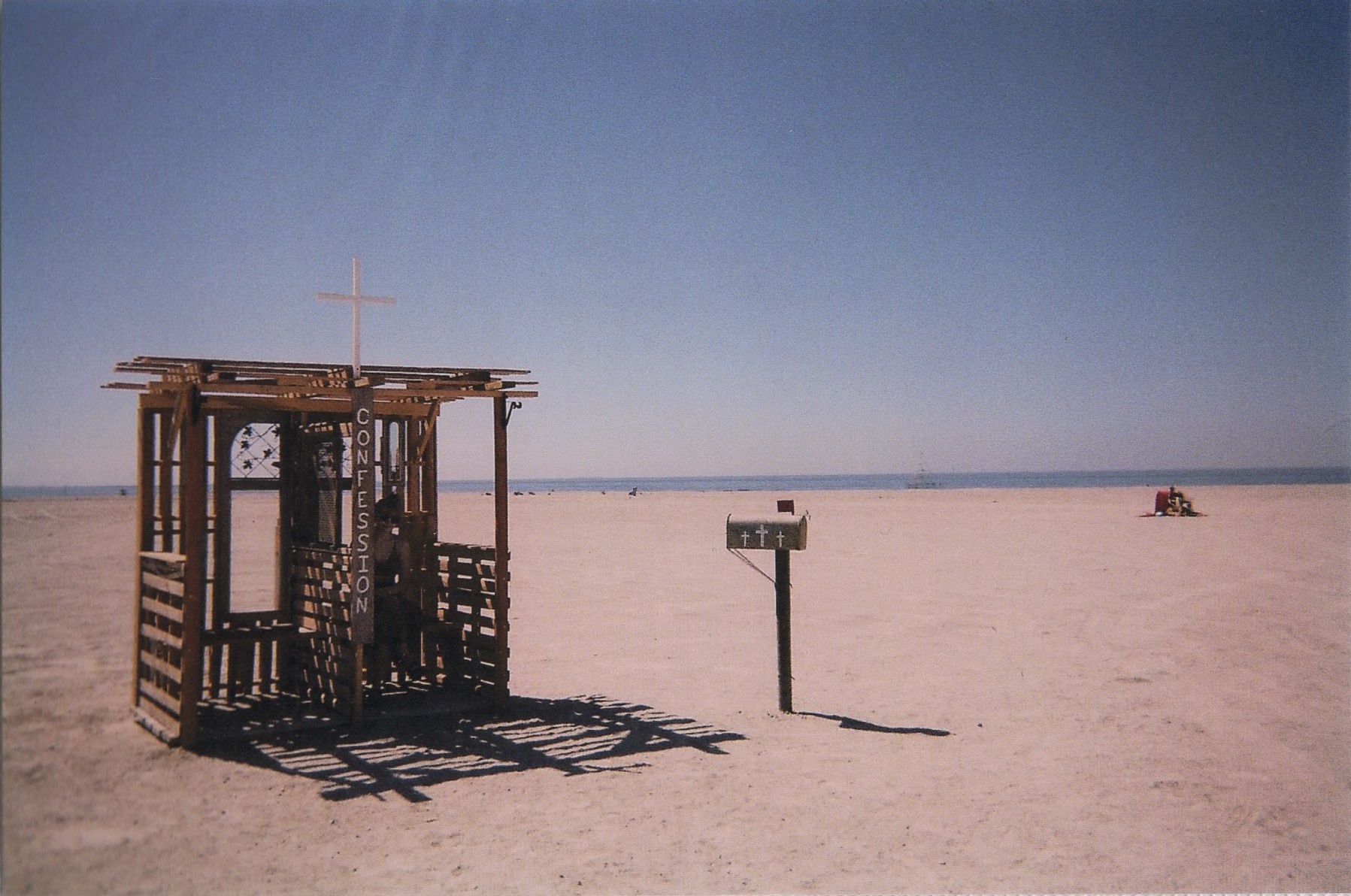
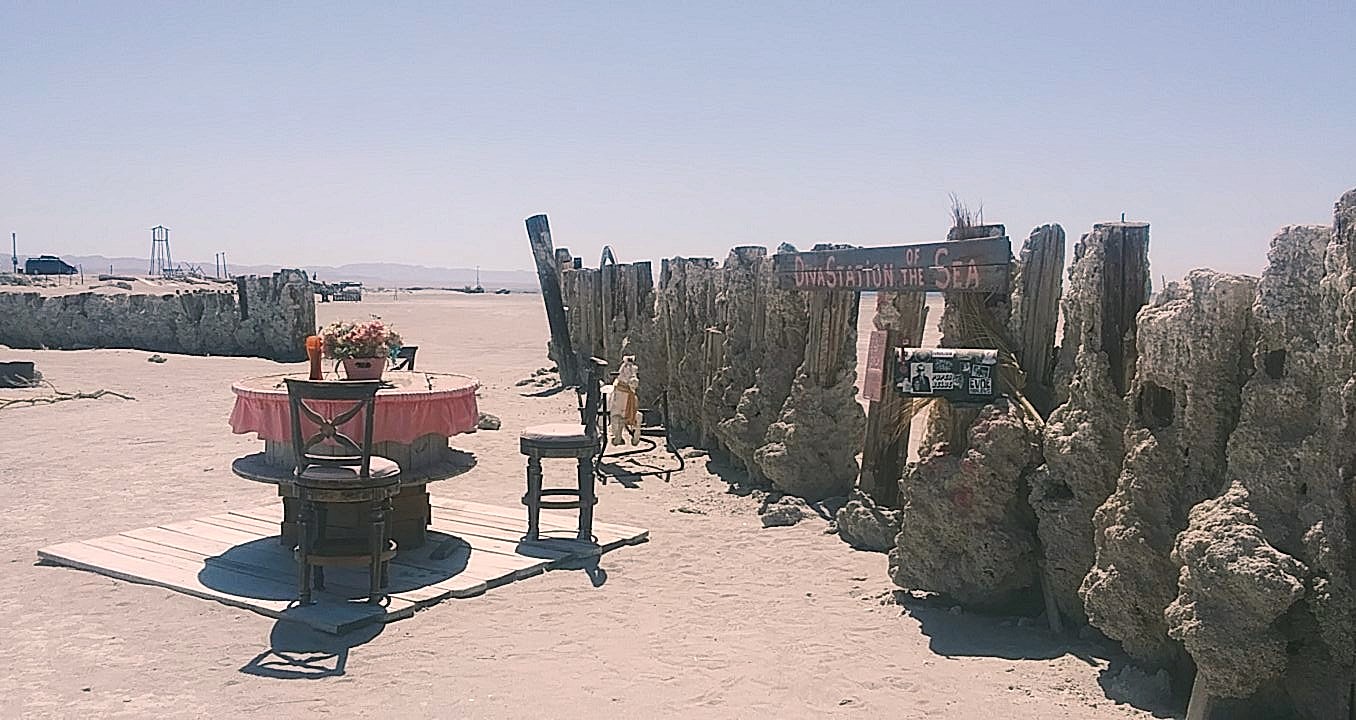
The smell of dead fish hangs heavy in my memory of the abandoned beach. I cannot describe this place in a way that does it justice. Scattered across the grey sand are small structures: a phone booth, a bar, a swing set. We did not see a single other person the entire time we were here.
deftones - i think about you all the time [visualizer]
If anyone knows where I can watch Dogwood's film Bombay Beach, please let me know.
Salvation Mountain:
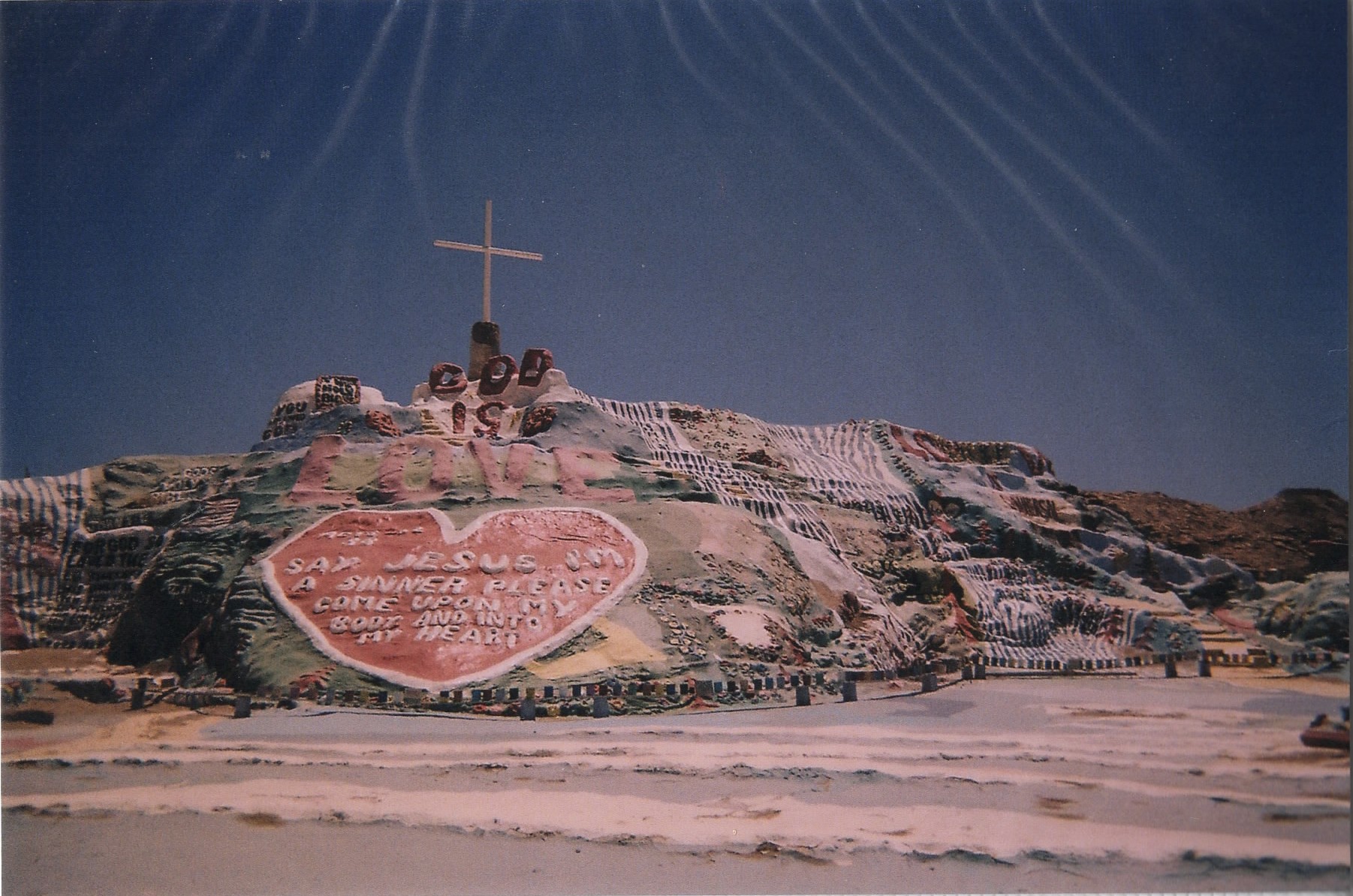
Spotting the mountain from the road, we pulled into the empty dust lot. We got out, and walked towards the mountain. "Hi!" said a voice. Both of us looked around, not knowing where the voice had come from. "Hello!" the voice said again, and this time we spotted a woman sitting in the shade of a small structure. This would be the only person we saw during our time by the Salton Sea. Diane was a volunteer, one of many who looked over the mountain and informed visitors. She told us the history of Salvation Mountain and it's creator, Leonard Knight. She recommended that we watch Knight's very charming video tour as we walked around.
Leonard Knight spent over two decades building this monument with adobe bricks, junk, and paint. Past the massive mountain displaying "God is Love" and the Sinner's prayer, there are tons of little rooms covered with murals and bible verses. It's beautiful, and Knight's message of "God loves everyone" is painted everywhere.
Slab City:
Yes, that Slab City. The Slab City you probably saw in some "TOP 10 CRAZIEST CITIES" video when you were 11. The so-called "last free place", the "lawless" city; The Slabs. We drove through the barren desert community, not one person in sight.
During WWII , the area was a military training base. But after only being active for three years, it was dismantled, leaving only concrete slabs. A few veterans stayed, and travellers looking for free camping set up around them. Over the years, it has become an increasingly popular destination for tourists, van-lifers, and those wanting to escape mainstream society. Most of the residents here are seasonal, using Slab City as a get-away from Northern winters. In the summer, you’ll find less than 200 people. In the winter, the population skyrockets into the thousands.
East Jesus:
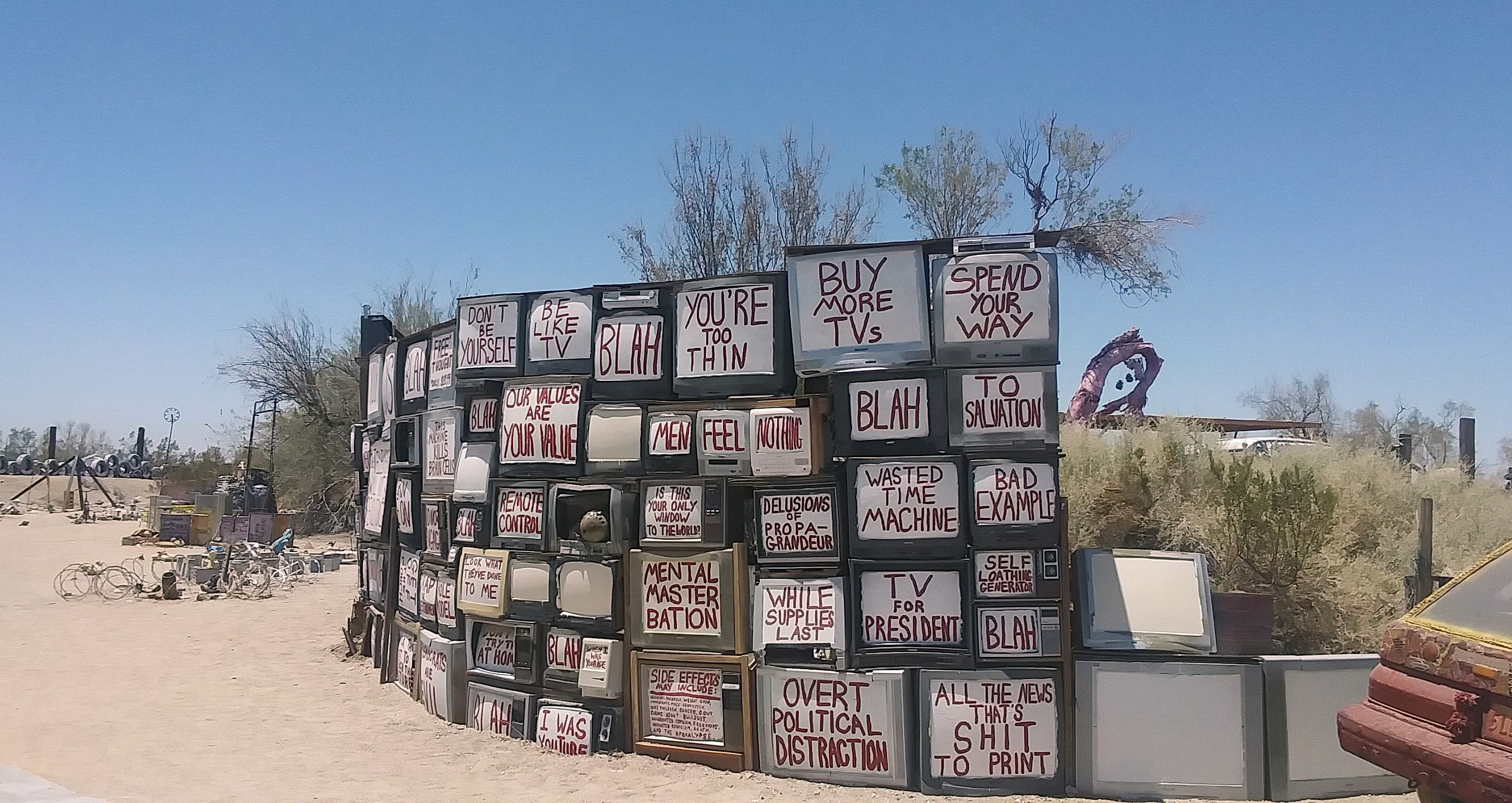

Our last stop was East Jesus. An arch made of old propane tanks marked the entrance to this large art-filled span of sand. My personal favorite installations were the TV Wall (pictured above) and the Tower of Barbarella (especially the chandelier of goose heads!).
Charlie Russel, also known as Container Charlie, left his job in the technology industry in 2006. He spent the next five years living outside of Slab City, building large, reclaimed-material sculptures on his land. After Charlie's death, the Chasterus Foundation and a number of local artists keep the art museum alive. Fun fact: The name refers to the term meaning "the middle of nowhere" (which East Jesus certainly is).
The south eastern coast of the Salton Sea was probably my favorite place we went that summer. It was completely unexpected and strange. The brutal sun and over 100 degree heat never let up, but that made it all the more memorable. I would absolutely recommend these places if you find yourself in the area.
sources/further reading:
Ologies: Haunted Hydrology (SPOOKY LAKES) with Geo Rutherford
The Atlas Obscura Podcast: Salton Sea
salvationmountain.us: Salvation Mountain
Boyd Matson: Salvation Mountain Leonard Knight
Wikipedia: Slab City, California
eastjesus.org: East Jesus
What does it mean to belong when you’re caught between worlds? To chase dreams when you’re met with failure at every step? Through monologue and movement, Fancy Dancer tells the incredible story of a young ballerina facing these questions. This autobiographical one-woman show is beautifully written by Larissa FastHorse.
In rural South Dakota, young Lara finds herself living undefined between her white small town and her indigenous Lakota community. Never knowing anyone like her, she finds herself in the image of world-renowned Osage ballerina Maria Tallchief. She sets her sights on becoming a fancy dancer and professional ballerina. Every night, she wishes on a star. Every day, she pushes past her limits to become the best she can. She finds sanctuary in dance as she overcomes social isolation and a physical disability. This play takes us through her incredible, deeply personal journey as she learns what it means to belong and what it means to dream.
The role of Lara is performed by Larissa FastHorse herself or by actress Burgandi Trejo Phoenix. I was lucky enough to attend a night where FastHorse was performing. Her background is in film, theatre, and television as a writer and director. She has over two dozen works that focus on sharing indigenous stories. The Thanksgiving Play, which she began writing in 2015, was the first Native-American written play to be produced on Broadway and to make the top 10 most produced plays list. She began writing Fancy Dancer around 2018. The first versions had a large cast and complex set. But as the script was revised and the core meaning of the story began to reveal itself, she ended up writing a one-person play. The grand set was also whittled down to be small and static. In this process, FastHorse found herself playing Lara.
FastHorse is not an actress by trade, but you'd never guess that from watching her performance. She captivates the audience from the first moment. Her vivid storytelling invites the audience into her childhood and teenage years. Alone onstage for 95 minutes, Larissa FastHorse relives the isolation of her own past. Her background in ballet shines through as she moves gracefully across the stage. The set is simple yet gorgeous: dark windows loom over a small dance studio. A chair and a barre are the only props she has. Light projections displayed over the entire stage bring you even further into Lara’s world.
This was truly one of the best plays I’ve seen in a long time. I found myself with tears rolling down my cheeks and a smile across my face multiple times. It is a masterpiece and a must-see. It speaks to anyone who has ever felt left out or out of place, and anyone who has dared to dream big. Lara's story of hope and perseverance is universal.
sources/further reading:
Seattle Rep: Fancy Dancer
Wikipedia: Larissa FastHorse
a discussion post for my archaeology class:
how do we use historical events to uphold certain narratives?
We are constantly using past events to push certain narratives whether we realize it or not. There is one historical event that stands out to me in particular. I believe its messaging is incredibly harmful, especially since it is so subtle.
I’m sure you’re familiar with Salem, Massachusetts. In 1692-93, fourteen women and five men were accused of practicing witchcraft and executed by hanging. Modern media often draws inspiration from these events. Hocus Pocus (1993) depicts three witches who were killed during the trials returning to Salem. Popular television series like Bewitched, Charmed, Sabrina the Teenage Witch, and WandaVision all play off this idea of witches in Salem, only to name a few. Today, the words “Salem” and “witches” are nearly inseparable.
Let me remind you that none of the accused people were witches. This may seem obvious, but modern narratives seem to skip over this fact. There is a lingering belief that these women did something wrong, that they were actually witches. This suggests that the accusations against them were, to some degree, reasonable. The modern interpretation of the Salem Witch Trials reinforces the narrative that women, especially older women, are “witches” or “hags”. Notice that the vast majority of the victims were between the ages of 50 and 80, the youngest being 35. While we often romanticize the trials and ignore the brutal reality, there is an underlying message that women are inherently corrupt, untrustworthy, or susceptible to influence from the devil (or other evils). You could argue many different reasons for this prejudice: a fear of women with power and/or autonomy, disdain for women who are “useless” (too old to bear children), or concern about non-conventional/non-christian beliefs, just to name a few. The bottom line is: a widespread distrust of women is ingrained in our society. Our current narrative about the tragedies in Salem only supports this idea.
The Salem Witch Trials occurred towards the end of mass witch hunts during the 16th and 17th centuries. 40,000-60,000 people (overwhelmingly women) were falsely accused of being witches and executed throughout Europe. The witch-panic is still around today. In the United States, the most recent influx was the Satanic Panic in the 80s. However, every year, thousands of people across the world are accused of witchcraft and killed. This modern witch hunting is especially prevalent in Africa.
These ideas are embedded within cultures throughout the world, and they have proved deadly over and over again throughout history.
sources/further reading:
Wikipedia: Salem Witch Trials
Wikipedia: Cultural Depictions of the Salem Witch Trials
Wikipedia: List of people of the Salem Witch Trials
BBC: The man battling Nigeria's 'witch-hunters'
Northwesten Journal of Law & Social Policy:
Hocus Pocus: Modern-Day Manifestations of Witch Hunts